Showing posts with label fiction. Show all posts

16 May 2015

Book Review: The Hollow Sun by D.L. Wainright


I recently finished The Hollow Sun by D.L. Wainright.  It is the first installment in the Hollow Sun series, and Wainright's first novel.


TheHollowSun.com
Twitter: @thehollowsun
Facebook: The Hollow Sun Series
Goodreads

Disclaimer: The author is a friend of mine, and I have known about some aspects of the book over the years as they were writing it. However, my love and loyalty to my friends does not over-power my sheer book nerdiness, and therefore this revue is my honest opinion. Friends come and go, but stories are forever!!


Description from the back cover:
Lucy Kincade is used to darkness, having lost her father in an accident when she was a child. Nothing, however, has prepared her for just how dark her reality will become. The truth should be an illuminating thing; but for Lucy, the more she discovers the more the light is leeched from her world. There's the monster who smiles at her from behind a human face, the friends who had lied about what they truly are, and the allies who promise protection while hiding bloody knives behind their backs. Just when she thinks she knows what's real, she's only found another layer of secrets waiting to be unraveled.

A supernatural fantasy book that drags you in, gets you hooked, and may have you running to your library's research section.

The story is about Lucy, a goth teenager just trying to get through school and enjoy life with her friends. But things start to change and she learns that the world around her is not what is seems.  Not only do things like vampire and werewolves exist, but they are a lot closer to home than she could have imagined. As she is learning about all the supernaturals in the world, she is also learning about herself and the father she'd lost so many years ago.  And this lesson is taking her on one hell of an adventure.

Wainright's story about teen Lucy and her discovering the secrets of the people and the world around her is laced with mythology and folklore from around the world.  And unlike most popular supernatural YA fiction, this folklore isn't pulled from film, tv, or the author's own creations.  More than once I found myself looking up some of the creatures and stories referenced because I wanted to learn more about it.  And more than once I was wishing that there was a nerdy community out there to discuss ideas and theories floating in my head about Lucy and her world! Told from her perspective, the reader is taken on the same journey that Lucy is on, discovering the truth about who her friends are, her family, and who she can and cannot trust.  The characters thwart the usual teen novel character tropes, while at the same remain familiar. You may see your own friends and enemies within them. If your friends and enemies are werewolves and vampires, that is.

The book is a fairly quick read, though sometimes I found myself stopping and finding passages to re-read to clarify the details in my head.  But mostly in the same way I would in an Agatha Christie story.  It combines the usual supernatural teen fantasy elements with folklore and has the feel of a mystery novel at the same time.  Almost like the Harry Potter series, even the most banal tidbit may end up being important later on.

So, I guess it's clear that I really liked this book. Ok, more like LOVED it.  The one complaint is that the sequel isn't ready yet, and I'm pretty sure D.L. is never going to let me read any bits before it's done, knowing how I want MOAR.

I would recommend this book to: teens and young adults; anyone who likes supernatural fiction; anyone who watches Supernatural; lovers of YA novels;  parents who don't want their kids reading Twilight; people who read Twilight and want less sparkle with their vampires; people who generally want supernatural fiction YA stories with a strong female lead and fewer Hollywood tropes; anyone who has ever argued about the historical folklore behind the Dracula stories; mythology and folklore nerds (I know my people are out there!), historically accurate goths; the curious folks.

Please go read this book so that I can talk about it with people!!!! It's no fun when the only person you knows whose read it is the author!!

Also, my friend totally finished that book he's been researching and writing for a long time, and I am so excited! Mostly because it's good. It would suck if I didn't like it. But how great is it to get to fangirl your friend?

04 August 2009

A-Coming through the ice cream bucket


While searching for a title on the library shelf, I came across one that sounded interesting - How I Became a Nun. I picked up the slender book, and the cover with a young girl eating a bright pink ice cream. My interest peaked, so I read. I was not expecting César Aira, or his unique story.

How I became a nun takes place in Rosario, Argentina. Our protagonist and narrator is a child named César Aira who refers to themself as both a boy and girl at different times. She (or he, though predominately she, so I'll use that pronoun here) exists in her head and only occasionally visits reality. A world of games, streams of description and wonder, and insight far beyond the average 6yr old abounds in her head, even as she sits in stillness listening to the radio. The outside world sees her as dumb and retarded, blind of the landscape she has created for herself. César's thoughts stream past in a manner similar to Salinger, and take on a hue of the other side of the looking glass. It is the surreal world of a little girl.
When the novel begins, the writing is clear and what one expects. César and her father are on an outing to get ice cream, which César has never tried. The excitement of sharing the treat with her father is dashed when the cold substance tastes too fowl to even lie about. Aira's descriptions are thick and wild and perfect. The reader tastes the foulness for themselves. After tears, arguing, and melted pink getting on everything, the father finds that there is something wrong with the ice cream and confronts the chap at the counter about it. This confrontation leads to the ice cream clerk's death - suffocation by strawberry. After, the father goes to jail and César to the hospital - the ice cream was tainted with cyanide, part of an epidemic in the area. The child survives the poisoning, and we are treated to the wild feverish recollections of a 6yr old in a hospital ward.
It is after the poisoning that the child's imaginations and narrations go down the rabbit hole. Cesar's games and observations only flirt with reality. Whether in school or playing with her neighbor she is constantly on the verge of drama and extreme. No emotion exists in the moderate.


Though a bit confusing, and not at all a traditional narrative, How I became a Nun is a worthwhile and interesting read.

28 May 2009

Do Androids Dream of Being King?

A lot of my reading of late has been of the research variety, and I have had some trouble in writing about it. Perhaps something to work on in the future? Also, I just deleted two drafts of reviews I never finished. The short is that I never finished Sly Mongoose and I read and enjoyed Coraline by Neil Gaiman.

In the meantime, I picked up two fiction titles recently that made me think, and made me smile.


We'll start with Rudyard Kipling's The Man Who Would Be King. I have always been a fan of Kipling's short stories that I read as a child, but never really thought of him in terms of "what should I read now?" I stumbled upon this book while in the stacks. I needed a small book to read on the train, and this tiny volume from 1898 (a mere 16cm) fit in my purse quite nicely. I am one who reads a book by its cover, so why not by its size?
I enjoyed this tale of two eccentric characters who conquer the mountainous lands of Kafiristan, in Afghanistan, only to be run out again. The style is of an old, ornate speech that sometimes you just NEED to sink your brain in to. For me, this style reads quickly. Though a very slow reader, I found with this novel the words just flying by, but without losing any meaning or beauty in them. And they are beautiful. Kipling describes a man's beheading, but with grace. It was his era and his way. Too often, with piles of archaeological data and analysis, I lose that sense of beauty in the written word. I know that I will seek this title out again, and that I need to read more Kipling!
We begin with the corespondent of a newspaper meeting Callahan on a train. They make a deal, that the narrator will give a message to Callahan's friend, Dravot, on his return train journey. The narrator later realizes the two are up to no good - blackmailing a Raja under the pretense of being from the press - a puts a (temporary) stop to their game. They later come to him in his office seeking aid - information about Kafiristan and a look at some maps. They have decided that India is too small for men such as them, and they will trek to the lands of Kafiristan and become Kings there. The recollection of their adventures comes from Callahan, when her returns to our narrators office a few years later, ragged, and in need of telling his tale. They had succeeded, but then were run out of the country, and Dravot killed.
It is an interesting thought, how these two characters can set out with such conviction against all odds and succeed. It is such an American ideal, coming from this British author. But then, Mad Dogs and Englishmen go out to rule EVERYONE. But how do these mighty giants of personality and will fail? Is it their desire to be Kings? To be gods? Is it the ego they have in walking in to a village and declaring themselves in charge? Dravot's death comes after he makes designs to marry, but is his need for a warm body his true downfall? I'm not saying Kipling answers these questions, but they are fun to think about. The English are so audacious to begin with, especially those with adventure in their blood living in Asia at the time of the story. This is a people who come from a small island, and are always desiring more space. A morbid part of me giggles upon seeing such an outrageous man have his spoils crash down upon his head - literally. Of course, it's sad as well - hopes and dreams crushed and all that.
Life happens, and there are good times and bad. At the end of the story Kipling does not offer us any consolations or soft promises of a better future. Our narrator meets two men, foils their blackmail plans, helps them w/ maps of the mountains, and listens to their story. This matter of fact perception of life appeals to me in literature. It's odd - life is hard and we seek literature to escape. But I have gotten so sick and tired of those who would sugar-coat the world that I am seeking out a harsher alternate reality.


I also (FINALLY) picked up Philip K. Dick's classic Do Androids Dream of Electric Sheep. Yes, I am incredibly late to the Philip K. Dick party. I learned of him late in life, and even when I worked in a science fiction library did not partake of his offerings (sob). I did take home an extra ACE Double Novel, and years later read Vulcan's Hammer. LOVE flowed over my brain like waterfalls and sunshine. This was an author for me. Do Androids is definitely one of him more famous works and I've been eying the library's copy for over a year, looking for a time to snatch it away.
Do Androids Dream of Electric Sheep follows Rick Deckard, bounty (android) hunter, who finds that he can discern a v. new and shiny, complex android and destroy them. He seeks to own a real, live animal in his post-nuclear war world, and dreams of money and fame. Taking out these androids is the key to this wealth. Along the way, however, he has to rethink what he does and why while his fragmented, dying Earth culture copes.
This novel has some key elements that appeal to me: future, post-nuclear war, space travel, and introspective on what makes us human. It takes place on Earth, even though it is during a time that has space travel. Most novels tend to deal directly with that space travel, with the colonies on the moon, Mars, station, etc. Dick instead takes a look at what, and who, is left behind. Those who do not have the money to emigrate must remain on the dust-choked, radiated planet, as do those who have been physically affected by the radiation. The honesty in this perspective is unique, I think, for the time period. Many times authors were so caught up in the glorious technological future that they forgot little things like social stratification and the economy. Many dreamed of futures where there were no poor or deranged. I feel that we always have these sorts of troubles, even if we do colonize Mars and destroy Earth, so I appreciate authors who explore this as well. I think that authors today look through that lens a little more.
With the new Nexus 6 android, many of the rules for Deckard's profession are broken. It is not the test he gives them that tells him the answer, he must use his instinct and heart. It is this that makes him believe that he may be the only one who can spot them. It is all based on empathy and caring about life. Androids cannot process empathy and would therefore not care about, say, ripping the legs off a spider. In our own world many people are like this, but on a post-nuclear Earth where most animals have died off, a religion based on empathy has emerged. You ask an android about hurting an animal, they cannot process that it is horrible. It's not just the answers, but their eyes and pulse. With the creation of an android that nearly fools even the most experienced bounty hunters, it begs the question about what makes us alive? What, aside from biology, makes us human. Indeed, even the biological component begins to fade with the newest androids. This question has plagued us from the beginning of robotics and the ideas behind AI. Asimov's I, Robot is about this question. Technology is making rethink our definitions of life, and how we define ourselves.

19 February 2008

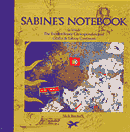
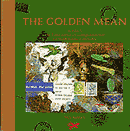
Griffin & Sabine - the artful correspondence

Griffin & Sabine: An Extraordinary Correspondence

I have just finished reading Nick Bantock's mystical Griffin and Sabine series about two artists who carry out a spacial correspondence and relationship. I had though the series was only three books, but just today learned that there are more, in the Morning Star trilogy! This makes me so very excited - I was happy with the ending of book three, but crave more!

A co-worker introduced me to this author after I saw the beautiful cover of a non-fiction book of his, Urgent 2nd class, which is about making things from ephemera. She recommended the Griffin and Sabine books. The art alone got me hooked.

The story of these two is told almost exclusively through their letters and postcards. The reader is more like a voyeur catching glances of their private thoughts as the mail passes through. It begins when Sabine finally gets the courage to send a postcard to Griffin, who lives in England halfway across the globe, to tell him that for years when he draws she can see through his eyes. No, this is NOT you average love story. They write back and forth and the mystical, psychic connection turns into a powerfully emotional one. But Griffin is troubled, and the reader is always a little unsure of whether both characters really exist, or if Griffin is just crazy. Plans to meet in person fall through and Griffin's mental health is, well, fragile. There are little notes of non-correspondence storytelling at the ends of the books, but the rest is through each character's point of view. The structure of this form makes the reader focus more on each word to try and decipher what is happening.

My favorite part of this series is the way in which Bantock tells the story. You have more depth and view than if it were from one person's, but are limited by not having the omnipotent angle. I love that he is re-thinking the concept of storytelling. When historians do research they look for 'primary sources,' and personal letters are often the important means of learning the stories of the past (history is just storytelling, in a way). Bantock applies this to fiction and fantasy. The artwork, too, is worth reading this series for. These two artists make their own postcards, and their letters and envelopes are also lavishly created in beautiful colors and images. He is so detailed that the handwriting is different, and even the artwork of each has its own character. You know who wrote each letter or postcard just by the style of it.

I highly recommend this series to anyone who loves ephemera, art, letters, or a good mystery. The books are short and can be gone through in a single sitting, but they leave a longer effect of almost childlike glee.

07 February 2008

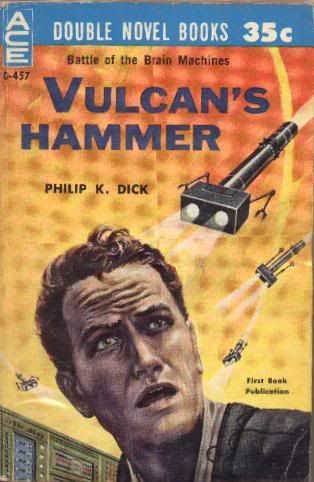
Vulcan's Hammer


VULCAN'S HAMMER
by Philip K. Dick
New York: Ace Books, 1960
Double Novel Books


On a recent trip to the city, I needed a small book to read. I grabbed a Double Novel Book from 1960 to carry in my purse. It contained Dick's Vulcan's Hammer and The Skynappers by John Brunner. I haven't gotten to the latter yet. I aquired this book sometime in college, while working at a science fiction library. I adore these little trade gems they used to put out at $.35 a copy.

Vulcan's Hammer takes place in a future Earth where a single body - Unity - governs the planet. It is set up like one huge beaurocratic entity with levels of Directors and clerks, making for a cut-throat work culture filled with paranoia and suspicion. Man's great achievement in the elimination of war and conflict was to create super computers that could rule in stead of a single human or human body. But there is a Movement afoot, led by the Healers, to bring down the super Vulcan computers a cease man's subservience to the machines.

The general idea of this novel is great. A constant theme in science fiction is the idea of eradicating war and conflict, either on Earth or in the Universe. Instead of a global tribunal or President of Earth, Dick chooses a machine. Taking away the unstable emotions and hypocrisies of humanity and ruling by logic and fact alone. In the crazy, war-torn world of today the idea is still tempting. But, as with any distopia, the perfect idea is never perfect. The urge to move up in the system turns people into spies, sneaks, and saboteurs. You create a larger and larger gap between the rich and the poor. And, of course, the big computer starts functioning in a way unimagined by it's creators. As in I, robot the machine tries to eliminate the human element, reasoning their existence away. It exemplifies many fears that came about when the computer age was in its infancy.
In 1960 the computer was a new technology not available to the everyman, but absolutely fascinating. Most computers took up entire rooms and were programmed using punch cards. They were utilized by governments and scientists, and it took trained experts to make them work. All of these ideas are how Dick envisions his Vulcan computers - massive chambers of tubes and wires that were only worked on by the most skilled of electricians and engineers, used by only the most elite in Unity. Of course, the story both praises the computer age and is wary of it. Dick almost seems jealous of the rift between the users and those below, when Father Fields, head of the Movement, says:

"You'll put an end to the cult of the technocrat?...For experts only - run by and for those oriented around verbal knowledge; I'm so damn sick of that. Mind stuff- as if manual skills like bricklaying and pip=fitting weren't worth talking about. As if all those people who work with their hands, the skill of their fingers...I'm tired of having those people looked down on."


This fear, mistrust, and jealousy is part of what leads to the Movement to begin with. Just as a communist revolt seeks to strike down the rich, elite bourgeoisie that seem to make living as poor or middle class unbearable.

Reading a story like this in 2008 puts the reader in a very different place than its original audience. Computers are now the tools of everyday, available to the masses. They are used not only for science and business, but for pleasure and entertainment - blogs, news, porn, lolcats, whatever. Robots also play a significant part of this future world, and though we don't have automated robot taxis, we are getting there with robot vacuums and manufacturing. Other little tidbits that call attention to its time: giving a sick man a cigarette (today, cigarettes are often used deliberately in fiction as part of character development; back then it was just so common that leaving them out was more of a statement), and all the people in charge being men. There are few women, and they play emotional people, or secretaries. This would also have been a 1960s cultural mindset. These little moments just made me smile while reading it. They brought me back to the time when there seemed to be more wide-eyed amazement in the world.

Despite the dated view of the computer, I think that the themes in Vulcan's Hammer are still relevant. So much today has been computerized and mechanized. More and more our lives exist on computer networks and government databases. The human element is being removed step by step - we are that mistrusted. And can you blame them? War and social upheaval are just as a part of the world today as fifty years ago. The temptation to trust important decisions to the non-human is not just an idea - computers that run simulations help make decisions for travel, war, and the economy. And we are more global today than ever. We're not yet at a single country with a single ruler, but if one considers 'power' in terms of the economic control, then things aren't that far off. I think there is still the opportunity for this type of future. Despite years of writers questioning AI the science continues to blossom. Are we doomed by our machines, or will they in time save us?


(image from wwww.philipkdick.com)

06 September 2007

Back in to Orbit


Orbiter

Warren Ellis's Orbiter is set on a future Earth. The scene opens on a dilapidated Kennedy Space Center that has become a shanty town. Manned space flight has ended. The worst has happened. A decade earlier the shuttle Venture and her crew vanished without a trace. Space exploration pretty much stopped.

Then suddenly the ship returns, her crew gone but for her captain. He is crazy. The ship is changed. Who will figure out the mystery? The military? The former astronauts? The rocket scientists? The shrink?

The story grips you in the ways that the science fiction from the 1950s did. I am a huge dork about space, space travel and exploration. I'm a wannabe astronaut who would be heartbroken if manned space flight ever truly ended.

I picked up this graphic novel for the same reason that I've picked up so many - Warren Ellis. And he does not disappoint. Orbiter is less of the cutting remarks and weirdness that marks so much of works, such as Transmetropolitan, and more focused on the science fiction story he is creating. Any fan of classic science fiction stories, of Asimov and Sagan, will enjoy Orbiter.

I suggest beginning with Ellis's introduction. It is far from necessary to enjoy the story, but it helps you appreciate where he is coming from. It is dedicated to the astronauts who died in the Columbia accident, and it is clear why. Any accident or problem that occurs with space flight threatens its future. The is a multi-billion dollar venture, and the public is always wary of putting human lives on the line. I feel that Orbiter comes from Ellis's heart, much more that those works that come from his internet surfing and wit. Oh, his wit and humour is still there. It is still a Warren Ellis work. But it feels different.

Orbiter is a must read for any Ellis fan, any sci-fi fan, and any space flight fan. Even people who don't like comics/graphic novels need to read this one. The art work by Colleen Doran is clean and beautiful. Just look at the amazing cover and you'll want to open it up for more.


(image from Amazon.com - buy Orbiter)

03 August 2007

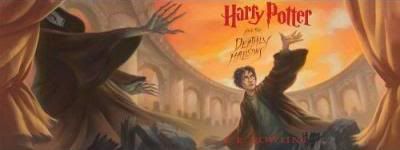
Harry Potter and the Dealthy Hallows


Yes, I am a Potter fan. I refused in the beginning to be a part of the hoopla, but my sister pushed me. I snuck a watch at the first movie (by then I think the second film was already out) and Maggie Smith made me read the book. ^_^

So, since then, the Potter series has eaten my soul. I went to college where I met people who were more in to the 'fandom' and sucked me into it a bit as well. I even took part in a roll-play or two (eek!). But now it is over. I have my soul back - a little battered and worn, but no longer lurking in dark corners of Hogwarts looking for horcruxes and potions masters.

I'd never been so excited to get a book as I was for this one (even more than Warren Ellis's Crooked Little Vein). For the first time ever, I pre-ordered it. It got to me on Saturday the 21st, I ripped open the box and began reading.

There were, of course mixed emotions throughout my reading. I am that annoying type of person who gets emotionally attached to fictional characters, so it was difficult seeing these people die and get hurt. In addition, Rowling went places I didn't want her to. I found myself yelling out loud at the lump of paper in front of me. The book was better written then some of the others (coughbook5cough). Though some sections were not written or plotted in the greatest way, I felt that style and grace were often put aside for the sake of the fans. There was a lot

I am actually finishing this 'review' months after my initial reading - just never got around to it. I think I'll read it again soonish and really pour out my thoughts. But overall, I'm both sad and glad that the series is over. I hope she never sells out and goes back on her word about not writing more about their lives. I think that their futures are important, but can be left in the realm of fanfic-ers.

05 June 2007

Fry me up a Hippo, you Liar

I am nearly done with Stephen Fry's The Hippopotamus. I know, reviews are usually done after the book is fully read, but this is more a review on the author.


This is the second book I have read by Stephen Fry
, one of my favorite actors. The other is The Liar. And yes, that is precisely why I wanted to read him. I saw that he had written a number of books, not just some lame memoir with six ghost writers feeding him words and grammar. And what I found was that he is actually a legitimate writer. Who knew. The whole search was spawned by my buying the DVDs of A Bit of Fry and Laurie. Hugh Laurie is also a writer of fiction, and pretty good as well.

But I have a bone to pick with Mr. Fry. He has me hooked and bemused, damnit. I cannot for the life of me figure if he's a good writer or not. Sure, I could read reviews by professionals and all that, but that takes away all the fun. What do professionals know, anyhow?

I can never figure out what the hell one of his books is about. The title is certainly no help. The Liar became clear about midway through, but I'll be damned if I can see the relation to hippos in the other. I'm probably missing something. It could be the whole stubborn personality of the main character (who I cannot for the life of me get to sound like anyone BUT Fry in my head). He's all quiet and drunk-like then bites your head off and charges. Or something. BUt even title aside, the style of narrative jumps around from character, POV and even chronologically. Both The Liar and The Hippopotamus take the scenic route through a story. There is a story, however. It's slow to appear, but there is a story to be had. But slow doesn't equal boring. That's the thing! I can hardly put the books down! The jumping to and fro is confusing sometimes, but more often intriguing. The storyline is either complex or weird enough to keep attention. The characters are incredibly delicious, and I find myself willing to put up with all of Mr. Fry's literary mishigas just to see what the hell happens to them all.


So, what does this all mean? Besides, of course, that I will likely continue to read his books until I figure it all out. Maybe whether or not he's any good doesn't matter. I enjoy reading him, so isn't that enough? But I'm a snob and I've seen so many terrible books that are better drooled upon than read.
I am also concerned about my biases. Of course all readings are subjective. However, are my opinions of him as an actor clouding my opinions of his writing? I have been a fan of his since I first set eyes on Jeeves as a child. I have sought out his movies, and bounced on the couch with glee when he shows up in something I'm watching. Despite my thoughts on actors writing books (which is usually a horrible mistake) I sought his out. Perhaps it is even the sound of his voice narrating in my head that sways me (I had the same exact issue with Hugh Laurie's The Gun Seller).


I also wonder if it is the British. I am not ashamed of admitting that, like many Americans, I have long been a fan of many things British. Having no cable as a I kid I grew up with many Brit-coms on PBS. Despite my efforts I have many "Britishisms" in my vocabulary. (Cursing in public goes much more smoothly when it's just a 'bloody hell' or 'bollocks' and no one really know s what you are saying. They tend to think the Brits sound posh, so it must be ok.) While traveling in Manhattan the other day, reading my Fry on the subway and ferry, I noticed just how much I was enjoying the main character's style of thought. It is so terribly British in a way that I really cannot put into words. I found myself playing with this style in my head - describing the city around me as curmudgeonly and pessimistically as Ted Wallace would. It was fun to then flit between that and the v. American 'urban beauty around me' style. It's a matter of the subway being either 'a wretched stinking box filled with all flavors of wretched stinking people who are just trying to get from one part of their wretched stinking lives to another' or 'an unique microcosm of the world with a million stories, lives, and experiences all crossing paths at that one glorious moment, never to be repeated' or something like that.

Oh well. ::shrugs:: I guess I am doomed to merely enjoy his movies, tv shows, AND books for all time, never quite knowing why.