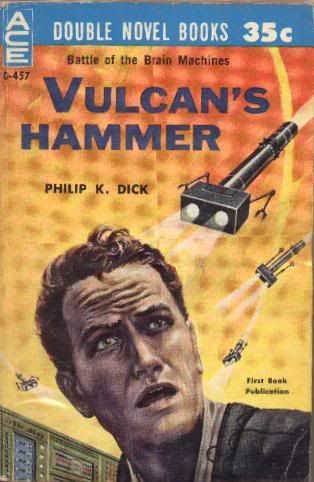
VULCAN'S HAMMER
by Philip K. Dick
New York: Ace Books, 1960
Double Novel Books
On a recent trip to the city, I needed a small book to read. I grabbed a Double Novel Book from 1960 to carry in my purse. It contained Dick's Vulcan's Hammer and The Skynappers by John Brunner. I haven't gotten to the latter yet. I aquired this book sometime in college, while working at a science fiction library. I adore these little trade gems they used to put out at $.35 a copy.
Vulcan's Hammer takes place in a future Earth where a single body - Unity - governs the planet. It is set up like one huge beaurocratic entity with levels of Directors and clerks, making for a cut-throat work culture filled with paranoia and suspicion. Man's great achievement in the elimination of war and conflict was to create super computers that could rule in stead of a single human or human body. But there is a Movement afoot, led by the Healers, to bring down the super Vulcan computers a cease man's subservience to the machines.
The general idea of this novel is great. A constant theme in science fiction is the idea of eradicating war and conflict, either on Earth or in the Universe. Instead of a global tribunal or President of Earth, Dick chooses a machine. Taking away the unstable emotions and hypocrisies of humanity and ruling by logic and fact alone. In the crazy, war-torn world of today the idea is still tempting. But, as with any distopia, the perfect idea is never perfect. The urge to move up in the system turns people into spies, sneaks, and saboteurs. You create a larger and larger gap between the rich and the poor. And, of course, the big computer starts functioning in a way unimagined by it's creators. As in I, robot the machine tries to eliminate the human element, reasoning their existence away. It exemplifies many fears that came about when the computer age was in its infancy.
In 1960 the computer was a new technology not available to the everyman, but absolutely fascinating. Most computers took up entire rooms and were programmed using punch cards. They were utilized by governments and scientists, and it took trained experts to make them work. All of these ideas are how Dick envisions his Vulcan computers - massive chambers of tubes and wires that were only worked on by the most skilled of electricians and engineers, used by only the most elite in Unity. Of course, the story both praises the computer age and is wary of it. Dick almost seems jealous of the rift between the users and those below, when Father Fields, head of the Movement, says:
"You'll put an end to the cult of the technocrat?...For experts only - run by and for those oriented around verbal knowledge; I'm so damn sick of that. Mind stuff- as if manual skills like bricklaying and pip=fitting weren't worth talking about. As if all those people who work with their hands, the skill of their fingers...I'm tired of having those people looked down on."
This fear, mistrust, and jealousy is part of what leads to the Movement to begin with. Just as a communist revolt seeks to strike down the rich, elite bourgeoisie that seem to make living as poor or middle class unbearable.
Reading a story like this in 2008 puts the reader in a very different place than its original audience. Computers are now the tools of everyday, available to the masses. They are used not only for science and business, but for pleasure and entertainment - blogs, news, porn, lolcats, whatever. Robots also play a significant part of this future world, and though we don't have automated robot taxis, we are getting there with robot vacuums and manufacturing. Other little tidbits that call attention to its time: giving a sick man a cigarette (today, cigarettes are often used deliberately in fiction as part of character development; back then it was just so common that leaving them out was more of a statement), and all the people in charge being men. There are few women, and they play emotional people, or secretaries. This would also have been a 1960s cultural mindset. These little moments just made me smile while reading it. They brought me back to the time when there seemed to be more wide-eyed amazement in the world.
Despite the dated view of the computer, I think that the themes in Vulcan's Hammer are still relevant. So much today has been computerized and mechanized. More and more our lives exist on computer networks and government databases. The human element is being removed step by step - we are that mistrusted. And can you blame them? War and social upheaval are just as a part of the world today as fifty years ago. The temptation to trust important decisions to the non-human is not just an idea - computers that run simulations help make decisions for travel, war, and the economy. And we are more global today than ever. We're not yet at a single country with a single ruler, but if one considers 'power' in terms of the economic control, then things aren't that far off. I think there is still the opportunity for this type of future. Despite years of writers questioning AI the science continues to blossom. Are we doomed by our machines, or will they in time save us?
(image from wwww.philipkdick.com)

