April is nearly over. I cannot believe it's flown by so fast, and I have accomplished nothing I had planed to. I did write a little this month, even poetry, which makes me very happy. I have not yet decided if it is sharable yet. Probably not. I took a last minute train trip to see friends, with my head and heart tied in knots, still asleep after a marathon weekend of singing. I was inspired by them, by Penn station, by the sunshine. But I think things need a little work before anyone sees them, if I ever get to sharing. I am still reticent, but a friend's recent writing and sharing of his work inspires me.
There is also this list. I have read so few (27/100) I am ashamed!! Too much to get read these days!
The BBC apparently believes most people will have only read 6 of the 100 books here:
1 Pride and Prejudice - Jane Austen
2 The Lord of the Rings - JRR Tolkien I have only read it in part, still need to get around to finishing.
3 Jane Eyre - Charlotte Bronte
4 Harry Potter series - JK Rowling
5 To Kill a Mockingbird - Harper Lee
6 The Bible - Only Genesis, for class. I get bored every time I try,
7 Wuthering Heights - Emily Bronte
8 Nineteen Eighty Four - George Orwell
9 His Dark Materials - Philip Pullman
10 Great Expectations - Charles Dickens
11 Little Women - Louisa M Alcott
12 Tess of the D’Urbervilles - Thomas Hardy
13 Catch 22 - Joseph Heller
14 Complete Works of Shakespeare - I've read many plays and sonnets, but not everything. Performed a few, too.
15 Rebecca - Daphne Du Maurier
16 The Hobbit - JRR Tolkien
17 Birdsong - Sebastian Faulk
18 Catcher in the Rye - JD Salinger
19 The Time Traveller’s Wife - Audrey Niffenegger
20 Middlemarch - George Eliot
21 Gone With The Wind - Margaret Mitchell
22 The Great Gatsby - F Scott Fitzgerald
23 Bleak House - Charles Dickens
24 War and Peace - Leo Tolstoy
25 The Hitch Hiker’s Guide to the Galaxy - Douglas Adams - One book shy of the series.
26 Brideshead Revisited - Evelyn Waugh
27 Crime and Punishment - Fyodor Dostoyevsky
28 Grapes of Wrath - John Steinbeck
29 Alice in Wonderland - Lewis Carroll
30 The Wind in the Willows - Kenneth Grahame
31 Anna Karenina - Leo Tolstoy
32 David Copperfield - Charles Dickens
33 Chronicles of Narnia - CS Lewis
34 Emma - Jane Austen
35 Persuasion - Jane Austen
36 The Lion, The Witch and The Wardrobe
37 The Kite Runner - Khaled Hosseini
38 Captain Corelli’s Mandolin - Louis De Bernieres
39 Memoirs of a Geisha - Arthur Golden
40 Winnie the Pooh - AA Milne
41 Animal Farm - George Orwell
42 The Da Vinci Code - Dan Brown
43 One Hundred Years of Solitude - Gabriel Garcia Marquez
44 A Prayer for Owen Meaney - John Irving
45 The Woman in White - Wilkie Collins
46 Anne of Green Gables - LM Montgomery
47 Far From The Madding Crowd - Thomas Hardy.
48 The Handmaid’s Tale - Margaret Atwood
49 Lord of the Flies - William Golding
50 Atonement - Ian McEwan
51 Life of Pi - Yann Martel
52 Dune - Frank Herbert
53 Cold Comfort Farm - Stella Gibbons
54 Sense and Sensibility - Jane Austen
55 A Suitable Boy - Vikram Seth.
56 The Shadow of the Wind - Carlos Ruiz Zafon
57 A Tale Of Two Cities - Charles Dickens
58 Brave New World - Aldous Huxley
59 The Curious Incident of the Dog in the Night-time - Mark Haddon
60 Love In The Time Of Cholera - Gabriel Garcia Marquez
61 Of Mice and Men - John Steinbeck
62 Lolita - Vladimir Nabokov
63 The Secret History - Donna Tartt
64 The Lovely Bones - Alice Sebold
65 Count of Monte Cristo - Alexandre Dumas
66 On The Road - Jack Kerouac - I am backwards and read Dharma Bums, which is like a sequel
67 Jude the Obscure - Thomas Hardy
68 Bridget Jones’s Diary - Helen Fielding
69 Midnight’s Children - Salman Rushdie
70 Moby Dick - Herman Melville
71 Oliver Twist - Charles Dickens
72 Dracula - Bram Stoker
73 The Secret Garden - Frances Hodgson Burnett
74 Notes From A Small Island - Bill Bryson
75 Ulysses - James Joyce
76 The Bell Jar - Sylvia Plath
77 Swallows and Amazons - Arthur Ransome
78 Germinal - Emile Zola
79 Vanity Fair - William Makepeace Thackeray
80 Possession - AS Byatt.
81 A Christmas Carol - Charles Dickens
82 Cloud Atlas - David Mitchell
83 The Color Purple - Alice Walker
84 The Remains of the Day - Kazuo Ishiguro
85 Madame Bovary - Gustave Flaubert
86 A Fine Balance - Rohinton Mistry
87 Charlotte’s Web - EB White
88 The Five People You Meet In Heaven - Mitch Albom
89 Adventures of Sherlock Holmes - Sir Arthur Conan Doyle
90 The Faraway Tree Collection - Enid Blyton
91 Heart of Darkness - Joseph Conrad
92 The Little Prince - Antoine De Saint-Exupery
93 The Wasp Factory - Iain Banks
94 Watership Down - Richard Adams
95 A Confederacy of Dunces - John Kennedy Toole
96 A Town Like Alice - Nevil Shute
97 The Three Musketeers - Alexandre Dumas
98 Hamlet - William Shakespeare - Why is this on here, when the complete works are listed? I know Hamlet is important, but so is King Lear
99 Charlie and the Chocolate Factory - Roald Dahl
100 Les Miserables - Victor Hugo
Showing posts with label writing. Show all posts
Showing posts with label writing. Show all posts
25 April 2011


11 September 2008
on teachers and writing....and Lincoln
Checked up on my old NYU writing teacher, Josh Shenk, to see what he's up to these days. Not teaching at NYU, for one. Also, seems he finished that book about Lincoln back in 2005. We have it at work, so it may be on my near-future reading list. Sadly I had plans to read through parts of Gimbutas's Civilization of the Goddess and Handbook of Landscape Archaeology next. Though non-fiction, Josh's Lincoln's Melancholy: how Depression Challenged a President and Fueled His Greatness is probably the easier read. I've been v. immersed in fiction of late, and I need to focus on some more useful reading. Gimbutas and Landscape are not falling away, though.
I liked Josh's class a lot. My writing in high school was always good enough that the teachers could ignore me and worry about those who couldn't string a coherent sentence together. That meant that I never got any better. Writing the Essay - the introductory writing class mandatory for all Arts & Crafts students at NYU - was usually dreaded. It was often taught by old near-retirement professors who didn't give a damn or graduate students who forced their own writing upon their captive audience. I had neither. I had Josh. The first time I had to get used to calling a teacher by their first name (I have no Ph.D, and am not Professor. And Mr Shenk is my father."). It was 15 students at 8am in the morning in a small library classroom. Since being in the library meant coffee had to be snuck in, ha had it changed to a room in the Expository Writing building ("I don't know about you, but at 8am, I need my coffee"). Fifteen students, mostly freshman, with a slightly crazed writer who loved his iPod like a child and bounced a MoMa bouncy ball on the subway platforms during his commute from Brooklyn (it was so gross).
Josh didn't have an ax to grind or anyone to impress. We read one small part of the then-in-progress Lincoln book and one article of his (it had already been published, so it wasn't like he was looking for positive affirmations). Other than that, he actually focused on us and our writing. It was the first time anyone had ever taken the time to really read my writing and work with me on improving it. I felt, for the first time, that I had truly learned something. He taught that the essay should be like his bouncy ball - bouncing along from image to idea to image and so forth until your final idea was reached. It was a journey that had two intermingled parts to it. At the end, he bought us all two-colored bouncy balls, a reminder of essay writing. I still have it. I still remember and try it that way.
He expanded what an essay meant, what it could convey. In addition to reading the essays from our textbook (edited by the head of Expository Writing, of course) we analyzed the essay-like qualities of poetry and music. There was much Bob Dylan and Bruce Springsteen played from the iPod. Long before encountering the inimitable Shea, this was my first experience with a teacher who thought outside the status quo, who pushed us to think.
This experience, sadly, set my standards too high. I transferred to a state school that didn't expect/demand that students write a proper paper until junior year. A school that held the little dears' hands through college so that they didn't have to learn too much and hurt themselves. Technicalities made it necessary that I take the intro writing course my senior year (they didn't have my WtE grades - I got an A-). It was taught by a misanthropic moron who liked rebel poets, and not much else, it seemed. He and I clashed from day one. And he barely helped those kids learn to write. I don't think he inspired anyone to write, or write better. I helped get a classmate through it, not him.
I missed Josh's class over the years. I missed teachers like him. So I want to read Lincoln's Melancholy. I'll let you all know about it when I'm done.
I liked Josh's class a lot. My writing in high school was always good enough that the teachers could ignore me and worry about those who couldn't string a coherent sentence together. That meant that I never got any better. Writing the Essay - the introductory writing class mandatory for all Arts & Crafts students at NYU - was usually dreaded. It was often taught by old near-retirement professors who didn't give a damn or graduate students who forced their own writing upon their captive audience. I had neither. I had Josh. The first time I had to get used to calling a teacher by their first name (I have no Ph.D, and am not Professor. And Mr Shenk is my father."). It was 15 students at 8am in the morning in a small library classroom. Since being in the library meant coffee had to be snuck in, ha had it changed to a room in the Expository Writing building ("I don't know about you, but at 8am, I need my coffee"). Fifteen students, mostly freshman, with a slightly crazed writer who loved his iPod like a child and bounced a MoMa bouncy ball on the subway platforms during his commute from Brooklyn (it was so gross).
Josh didn't have an ax to grind or anyone to impress. We read one small part of the then-in-progress Lincoln book and one article of his (it had already been published, so it wasn't like he was looking for positive affirmations). Other than that, he actually focused on us and our writing. It was the first time anyone had ever taken the time to really read my writing and work with me on improving it. I felt, for the first time, that I had truly learned something. He taught that the essay should be like his bouncy ball - bouncing along from image to idea to image and so forth until your final idea was reached. It was a journey that had two intermingled parts to it. At the end, he bought us all two-colored bouncy balls, a reminder of essay writing. I still have it. I still remember and try it that way.
He expanded what an essay meant, what it could convey. In addition to reading the essays from our textbook (edited by the head of Expository Writing, of course) we analyzed the essay-like qualities of poetry and music. There was much Bob Dylan and Bruce Springsteen played from the iPod. Long before encountering the inimitable Shea, this was my first experience with a teacher who thought outside the status quo, who pushed us to think.
This experience, sadly, set my standards too high. I transferred to a state school that didn't expect/demand that students write a proper paper until junior year. A school that held the little dears' hands through college so that they didn't have to learn too much and hurt themselves. Technicalities made it necessary that I take the intro writing course my senior year (they didn't have my WtE grades - I got an A-). It was taught by a misanthropic moron who liked rebel poets, and not much else, it seemed. He and I clashed from day one. And he barely helped those kids learn to write. I don't think he inspired anyone to write, or write better. I helped get a classmate through it, not him.
I missed Josh's class over the years. I missed teachers like him. So I want to read Lincoln's Melancholy. I'll let you all know about it when I'm done.
19 February 2008
Griffin & Sabine - the artful correspondence
Griffin & Sabine: An Extraordinary Correspondence
I have just finished reading Nick Bantock's mystical Griffin and Sabine series about two artists who carry out a spacial correspondence and relationship. I had though the series was only three books, but just today learned that there are more, in the Morning Star trilogy! This makes me so very excited - I was happy with the ending of book three, but crave more!
A co-worker introduced me to this author after I saw the beautiful cover of a non-fiction book of his, Urgent 2nd class, which is about making things from ephemera. She recommended the Griffin and Sabine books. The art alone got me hooked.
The story of these two is told almost exclusively through their letters and postcards. The reader is more like a voyeur catching glances of their private thoughts as the mail passes through. It begins when Sabine finally gets the courage to send a postcard to Griffin, who lives in England halfway across the globe, to tell him that for years when he draws she can see through his eyes. No, this is NOT you average love story. They write back and forth and the mystical, psychic connection turns into a powerfully emotional one. But Griffin is troubled, and the reader is always a little unsure of whether both characters really exist, or if Griffin is just crazy. Plans to meet in person fall through and Griffin's mental health is, well, fragile. There are little notes of non-correspondence storytelling at the ends of the books, but the rest is through each character's point of view. The structure of this form makes the reader focus more on each word to try and decipher what is happening.
My favorite part of this series is the way in which Bantock tells the story. You have more depth and view than if it were from one person's, but are limited by not having the omnipotent angle. I love that he is re-thinking the concept of storytelling. When historians do research they look for 'primary sources,' and personal letters are often the important means of learning the stories of the past (history is just storytelling, in a way). Bantock applies this to fiction and fantasy. The artwork, too, is worth reading this series for. These two artists make their own postcards, and their letters and envelopes are also lavishly created in beautiful colors and images. He is so detailed that the handwriting is different, and even the artwork of each has its own character. You know who wrote each letter or postcard just by the style of it.
I highly recommend this series to anyone who loves ephemera, art, letters, or a good mystery. The books are short and can be gone through in a single sitting, but they leave a longer effect of almost childlike glee.

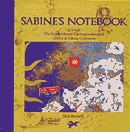
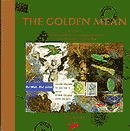
I have just finished reading Nick Bantock's mystical Griffin and Sabine series about two artists who carry out a spacial correspondence and relationship. I had though the series was only three books, but just today learned that there are more, in the Morning Star trilogy! This makes me so very excited - I was happy with the ending of book three, but crave more!
A co-worker introduced me to this author after I saw the beautiful cover of a non-fiction book of his, Urgent 2nd class, which is about making things from ephemera. She recommended the Griffin and Sabine books. The art alone got me hooked.
The story of these two is told almost exclusively through their letters and postcards. The reader is more like a voyeur catching glances of their private thoughts as the mail passes through. It begins when Sabine finally gets the courage to send a postcard to Griffin, who lives in England halfway across the globe, to tell him that for years when he draws she can see through his eyes. No, this is NOT you average love story. They write back and forth and the mystical, psychic connection turns into a powerfully emotional one. But Griffin is troubled, and the reader is always a little unsure of whether both characters really exist, or if Griffin is just crazy. Plans to meet in person fall through and Griffin's mental health is, well, fragile. There are little notes of non-correspondence storytelling at the ends of the books, but the rest is through each character's point of view. The structure of this form makes the reader focus more on each word to try and decipher what is happening.
My favorite part of this series is the way in which Bantock tells the story. You have more depth and view than if it were from one person's, but are limited by not having the omnipotent angle. I love that he is re-thinking the concept of storytelling. When historians do research they look for 'primary sources,' and personal letters are often the important means of learning the stories of the past (history is just storytelling, in a way). Bantock applies this to fiction and fantasy. The artwork, too, is worth reading this series for. These two artists make their own postcards, and their letters and envelopes are also lavishly created in beautiful colors and images. He is so detailed that the handwriting is different, and even the artwork of each has its own character. You know who wrote each letter or postcard just by the style of it.
I highly recommend this series to anyone who loves ephemera, art, letters, or a good mystery. The books are short and can be gone through in a single sitting, but they leave a longer effect of almost childlike glee.
Subscribe to:
Comments (Atom)