07 July 2009

Eddings


Reading characters

I began reading David and Leigh Eddings's The Elder Gods after I heard of his death. I was very saddened by his passing. His novels, particularly his large series about Belgarion, have meant a great deal to me. I had read v. little medieval-style fantasy before my best friend sort of forced me to read the Belgariad. Now, I'm hooked. And, of course, sad that it's over.
Reading The Elder Gods has actually made me homesick (booksick?) for the world of the Belgariad, and missing some of the people in it. Eddings built worlds and people that stay with you. I dare you not to crush on Silk, adore Barak, want to bitch slap C'Nedra or fall in love with Durnik and plot to steal him away from the most powerful sorceress in multiple worlds. Dare you. Of course the story is important and well developed, but the characters are the shinging stars. Eddings used archetypes for his characters, so they always feel comfortable and familiar to begin with. From there he makes them lovable. So you keep reading. You want to see more of Barak and his jovial nature, and you wonder about all the mischief Silk can get in to. And you cry a little when they die, and a little more when they fall in love with someone who isn't you (What, besides incomparable beauty, a big heart, and nearly more power than the gods does she have that I don't?! I'm younger, you know!).

So, in the current series there are of course characters written to win you over. One that stands out to me already (about a third of the way in) is Red-Beard. Do they know that I adore the jovial big guy? They smarter than he looks burly one? Is that why they (David Edding's ewife, Leigh, now gets double billing - she's been helping for years!) keep writing this character in to the stories? It's the guy you always want a to have a pint with. That's who Barak is. That's who Red-Beard is. He makes me remember the good times I strike>had read with him. I keep fearing this means he will die when the big war comes. It's good story telling - not everyone you love can live in the end. ::sigh::

After this first Dreamers book, I think I'll go back and finish the Mallorean. I really need to close the door on that story. I need to know how it ends - how they catch Zandramas, how Belgarian gets Ce'Nedra and their son through it. Who dies. Who Belgarath and Beldin insult and how. It makes me laugh and tear up all at once.

Goodbye, Mr. Eddings. You are missed. Perhaps Leigh will write some more on her own.

28 May 2009

Do Androids Dream of Being King?

A lot of my reading of late has been of the research variety, and I have had some trouble in writing about it. Perhaps something to work on in the future? Also, I just deleted two drafts of reviews I never finished. The short is that I never finished Sly Mongoose and I read and enjoyed Coraline by Neil Gaiman.

In the meantime, I picked up two fiction titles recently that made me think, and made me smile.


We'll start with Rudyard Kipling's The Man Who Would Be King. I have always been a fan of Kipling's short stories that I read as a child, but never really thought of him in terms of "what should I read now?" I stumbled upon this book while in the stacks. I needed a small book to read on the train, and this tiny volume from 1898 (a mere 16cm) fit in my purse quite nicely. I am one who reads a book by its cover, so why not by its size?
I enjoyed this tale of two eccentric characters who conquer the mountainous lands of Kafiristan, in Afghanistan, only to be run out again. The style is of an old, ornate speech that sometimes you just NEED to sink your brain in to. For me, this style reads quickly. Though a very slow reader, I found with this novel the words just flying by, but without losing any meaning or beauty in them. And they are beautiful. Kipling describes a man's beheading, but with grace. It was his era and his way. Too often, with piles of archaeological data and analysis, I lose that sense of beauty in the written word. I know that I will seek this title out again, and that I need to read more Kipling!
We begin with the corespondent of a newspaper meeting Callahan on a train. They make a deal, that the narrator will give a message to Callahan's friend, Dravot, on his return train journey. The narrator later realizes the two are up to no good - blackmailing a Raja under the pretense of being from the press - a puts a (temporary) stop to their game. They later come to him in his office seeking aid - information about Kafiristan and a look at some maps. They have decided that India is too small for men such as them, and they will trek to the lands of Kafiristan and become Kings there. The recollection of their adventures comes from Callahan, when her returns to our narrators office a few years later, ragged, and in need of telling his tale. They had succeeded, but then were run out of the country, and Dravot killed.
It is an interesting thought, how these two characters can set out with such conviction against all odds and succeed. It is such an American ideal, coming from this British author. But then, Mad Dogs and Englishmen go out to rule EVERYONE. But how do these mighty giants of personality and will fail? Is it their desire to be Kings? To be gods? Is it the ego they have in walking in to a village and declaring themselves in charge? Dravot's death comes after he makes designs to marry, but is his need for a warm body his true downfall? I'm not saying Kipling answers these questions, but they are fun to think about. The English are so audacious to begin with, especially those with adventure in their blood living in Asia at the time of the story. This is a people who come from a small island, and are always desiring more space. A morbid part of me giggles upon seeing such an outrageous man have his spoils crash down upon his head - literally. Of course, it's sad as well - hopes and dreams crushed and all that.
Life happens, and there are good times and bad. At the end of the story Kipling does not offer us any consolations or soft promises of a better future. Our narrator meets two men, foils their blackmail plans, helps them w/ maps of the mountains, and listens to their story. This matter of fact perception of life appeals to me in literature. It's odd - life is hard and we seek literature to escape. But I have gotten so sick and tired of those who would sugar-coat the world that I am seeking out a harsher alternate reality.
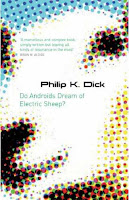


I also (FINALLY) picked up Philip K. Dick's classic Do Androids Dream of Electric Sheep. Yes, I am incredibly late to the Philip K. Dick party. I learned of him late in life, and even when I worked in a science fiction library did not partake of his offerings (sob). I did take home an extra ACE Double Novel, and years later read Vulcan's Hammer. LOVE flowed over my brain like waterfalls and sunshine. This was an author for me. Do Androids is definitely one of him more famous works and I've been eying the library's copy for over a year, looking for a time to snatch it away.
Do Androids Dream of Electric Sheep follows Rick Deckard, bounty (android) hunter, who finds that he can discern a v. new and shiny, complex android and destroy them. He seeks to own a real, live animal in his post-nuclear war world, and dreams of money and fame. Taking out these androids is the key to this wealth. Along the way, however, he has to rethink what he does and why while his fragmented, dying Earth culture copes.
This novel has some key elements that appeal to me: future, post-nuclear war, space travel, and introspective on what makes us human. It takes place on Earth, even though it is during a time that has space travel. Most novels tend to deal directly with that space travel, with the colonies on the moon, Mars, station, etc. Dick instead takes a look at what, and who, is left behind. Those who do not have the money to emigrate must remain on the dust-choked, radiated planet, as do those who have been physically affected by the radiation. The honesty in this perspective is unique, I think, for the time period. Many times authors were so caught up in the glorious technological future that they forgot little things like social stratification and the economy. Many dreamed of futures where there were no poor or deranged. I feel that we always have these sorts of troubles, even if we do colonize Mars and destroy Earth, so I appreciate authors who explore this as well. I think that authors today look through that lens a little more.
With the new Nexus 6 android, many of the rules for Deckard's profession are broken. It is not the test he gives them that tells him the answer, he must use his instinct and heart. It is this that makes him believe that he may be the only one who can spot them. It is all based on empathy and caring about life. Androids cannot process empathy and would therefore not care about, say, ripping the legs off a spider. In our own world many people are like this, but on a post-nuclear Earth where most animals have died off, a religion based on empathy has emerged. You ask an android about hurting an animal, they cannot process that it is horrible. It's not just the answers, but their eyes and pulse. With the creation of an android that nearly fools even the most experienced bounty hunters, it begs the question about what makes us alive? What, aside from biology, makes us human. Indeed, even the biological component begins to fade with the newest androids. This question has plagued us from the beginning of robotics and the ideas behind AI. Asimov's I, Robot is about this question. Technology is making rethink our definitions of life, and how we define ourselves.

09 October 2008

I do it every time...current reading

Once again, reading too much at once.

I had ordered Tobias Bucknell's Sly Mongoose through ILLwhen I first read about it - shortly after it came out. Being so new, most places wouldn't lend it. So I began something else in the meantime - Lincoln's Melancholy (see mention here). I'm enjoying it. I don't read too much non-fiction that isn't anthropology, archaeology, or mandated for class. This is something very different - historical psychology of sorts. I'm only up to 1841 and one of Lincoln's great breakdowns and crazy moments. He jumped out a window.

A couple days ago Sly Mongoose came in. So I started it. The loan period on it isn't v. long, and I doubt they'll grant a renewal since it is from their new books shelf. Not sure what I think thus far. It's heavy sci-fi spec - he's making up new planets, species, words - the whole deal. Thus far a guy fell from space, a city in the sky is near poverty, and a dude is dead. Too early to tell.

It is still interesting how our societies idea of spec fic has changed. The sci-fi that caught me on to the genre was the classic Asimov-type stuff of the 1950s and 60s. Most of the scenarios were utopias, or utopias crumbling. Or they were hopeful - in the future all is equal and cars fly. I still gravitate twds that type now and then. Sometimes you need optimism and flying cars.
Already in Sly Mongoose it is aparent that the future is not happy alien friendships. There's been invasion, denial of aliens, death, and poverty. And I'm less than 50 pages in. But that's good sci-fi, too. What WILL the future be like? Why will we leave this planet for another, and who among us will leave? It's naive to think that aliens species we encounter will be friendly. It's good to really think, "What's possible?"

So I'm reading about the past and future - all while trying to forget the present.

Also, have fallen in love with the illustrations of Laurel Long. Picked up The Magic Nesting Doll because of the pretty cover. Now have another by her and one on the way. Her style is elegant with a Russian feel to it. Image search for her on google

25 September 2008

Books on everything

When I fist began this blog, one of my first posts was about a book I came across on being a male escort. Today I came across another that also made me think about the kinds of reading out there - The Ultimate Guide to Anal Sex for Men. Turns out it's part of a series of sorts on sexual practices. There is one for anal sex and women, fellatio, strap-ons, lesbian pregnancy, etc. Yes, they will publish anything.

In today's society where it ok to talk about sex, if not mandated, these kinds of books are expected. Sex and sexuality are taught as classes in college; students major in the study. The library I work in not only holds the aforementioned male escort tbook, but also The new topping book as well as many older books written on various sex subjects. t Television and movies no longer sensually hint at the act but show the characters in flagrante delecto (I have no problem saying that people are having sex, intercourse, coitus, etc. I just love that phrase!). Books and series like Sex & the City or Straight up & Dirty have told women, at least, that it's not just ok to be sexual, but to declare it to world! With details!

I know that I am not the only one who has looked at this openness and wondered, is it all it's cracked up to be? Have we lost all sense of modesty, or of romance? Are we too quick to rationalize our sexual desires, name them and put a psychological reasoning behind it all? Can you really have irrational, spontaneous passion if you'd been planning it all day like you read in Redbook? Sex as reproduction is what we all in the animal kingdom do. And for a few of us lucky(??) extra-intelligent species, there is enjoyment in it. I am sure that there is a lot for psychology to say about the reasons why we are a culture obsessed with sex, yadda yadda yadda, but I don't really care. We are. Besides, a lot of it is just due to past repressions, anyway. But now we are obsessed with talking about sex, and apparently, reading about it. I wonder, with all this expose, if sex can still be personal, intimate? Many would make us think that if we don't share openly our sex lives or don't openly experiment with different positions that we're prudes and stuck in the dark ages. Women are attacked for not being feminists and embracing their sensuality. But this isn't the place for one of my rants on sex and culture. This is about The Ultimate Guide to Anal Sex for Men.

I have this thing with sex instruction books like the Ultimate Guides mentioned above. Yes, these books in particular normalize previously "underground" "unspoken" practices, and that's good in a way. But I can't help but feel like it also sterilizes them! It takes something that we do for pleasure and turns it in to school! I can't imagine desiring to study for my next date. For centuries people have been having sex of all kinds with all sorts of people and things - sometimes it was good, sometimes it wasn't. They learned and grew. Lesbians aren't new, and I highly doubt strap-ons are that novel, either. Must we all go in to our first experiences as experts? Where's the fun in that?! Sure, sex ala Bushnell's Samantha may be fun, but so is the journey there. First times are awkward, weird, fun, and memorable. Did I mention fun? The mystery of it is part of that.

So, it's great that you know a lot about anal sex and want to share it. And I understand that someone wants to learn about it. But why take the leap a little blindly? You can know how to be safe without getting a master's degree on the subject. Enjoy growing through experiences! And for pete's sake, don't take it all so damn seriously!!

10.09 EDIT - Just came across The Lesbian S/M Safety Manual edited by Pat Califia. The synop on the back begins, "This handy guide is an essential item for the leather dyke who wants to be well-informed about how to play safe and stay healthy." Ok, for safety (in BDSM, certain scenarios), I get having a book.

11 September 2008

on teachers and writing....and Lincoln

Checked up on my old NYU writing teacher, Josh Shenk, to see what he's up to these days. Not teaching at NYU, for one. Also, seems he finished that book about Lincoln back in 2005. We have it at work, so it may be on my near-future reading list. Sadly I had plans to read through parts of Gimbutas's Civilization of the Goddess and Handbook of Landscape Archaeology next. Though non-fiction, Josh's Lincoln's Melancholy: how Depression Challenged a President and Fueled His Greatness is probably the easier read. I've been v. immersed in fiction of late, and I need to focus on some more useful reading. Gimbutas and Landscape are not falling away, though.


I liked Josh's class a lot. My writing in high school was always good enough that the teachers could ignore me and worry about those who couldn't string a coherent sentence together. That meant that I never got any better. Writing the Essay - the introductory writing class mandatory for all Arts & Crafts students at NYU - was usually dreaded. It was often taught by old near-retirement professors who didn't give a damn or graduate students who forced their own writing upon their captive audience. I had neither. I had Josh. The first time I had to get used to calling a teacher by their first name (I have no Ph.D, and am not Professor. And Mr Shenk is my father."). It was 15 students at 8am in the morning in a small library classroom. Since being in the library meant coffee had to be snuck in, ha had it changed to a room in the Expository Writing building ("I don't know about you, but at 8am, I need my coffee"). Fifteen students, mostly freshman, with a slightly crazed writer who loved his iPod like a child and bounced a MoMa bouncy ball on the subway platforms during his commute from Brooklyn (it was so gross).
Josh didn't have an ax to grind or anyone to impress. We read one small part of the then-in-progress Lincoln book and one article of his (it had already been published, so it wasn't like he was looking for positive affirmations). Other than that, he actually focused on us and our writing. It was the first time anyone had ever taken the time to really read my writing and work with me on improving it. I felt, for the first time, that I had truly learned something. He taught that the essay should be like his bouncy ball - bouncing along from image to idea to image and so forth until your final idea was reached. It was a journey that had two intermingled parts to it. At the end, he bought us all two-colored bouncy balls, a reminder of essay writing. I still have it. I still remember and try it that way.
He expanded what an essay meant, what it could convey. In addition to reading the essays from our textbook (edited by the head of Expository Writing, of course) we analyzed the essay-like qualities of poetry and music. There was much Bob Dylan and Bruce Springsteen played from the iPod. Long before encountering the inimitable Shea, this was my first experience with a teacher who thought outside the status quo, who pushed us to think.
This experience, sadly, set my standards too high. I transferred to a state school that didn't expect/demand that students write a proper paper until junior year. A school that held the little dears' hands through college so that they didn't have to learn too much and hurt themselves. Technicalities made it necessary that I take the intro writing course my senior year (they didn't have my WtE grades - I got an A-). It was taught by a misanthropic moron who liked rebel poets, and not much else, it seemed. He and I clashed from day one. And he barely helped those kids learn to write. I don't think he inspired anyone to write, or write better. I helped get a classmate through it, not him.
I missed Josh's class over the years. I missed teachers like him. So I want to read Lincoln's Melancholy. I'll let you all know about it when I'm done.

27 August 2008

too.many.books

Haven't we all said it at one time? Thought it? Considered buying the t-shirt? "Too many books, too little time."

Now I find myself living it.

I am continuously caught in the trap of reading two to three books at once. Or picking up a graphic novel or two on the side. Ordering books from ILL as I see them, despite surely NOT having the time to finish them before they're due. Suddenly the overdue notices spring up on you!
I am currently reading the novelization of Fritz Lang's film Metropolis by his wife Thea Harbou, a version illustrated beautifully by Michael Kaluta. I keep being torn from it by other things and life. I must focus on this one.
I had begun The Threepenny Opera but I think I'll drop it for now. I can learn of the play's plot later.
Recently author John Scalzi released a new book, and reviews of it (on one or more of the various blogs I read that would mention such things) mad me think that I should read Old Man's War first. I'm 50 pages in and I love it. Good sci-fi and humor - just what I need right now. Space travel is my favorite.
While at the public library looking for something completely different I stumbled upon the comic Marvel 1602. It's Marvel characters in the year 1602. Not a big X-men fan, so it's not doing too much for me. I can only pick out a few of the characters anyway. Not sure if I'll finish it or not. Depends on how soon the due date sneaks up on me.
Another sci-fi book is (perhaps) on its way to me via ILL. It JUST came out, so I'm doubting anyone will send it. Prolly better that way - gives me more time to read the above! TI's called Sly Mongoose and I can no longer remember what it's about. I read about it online (BoingBoing?) and ordered it two seconds later. Damnit, libraries will be the end to me, I swear! In addition, a book about food culture and growing, Animal, vegetable, miracle: a year of food life by Barbara Kingsolver was recommended to me. Depends on how the next few weeks go before I think of cracking the cover. I also want to read, at some point, the same author's Poisonwood Bible.


I've been thinking lately about my reading. I am always reading something - I often carry a purse that a book will fit in. But lately I think my reading has been taking my time, energy, and brain power away from other things in life. Important things. Like my future. I'm caught at the moment in a paralyzing fear and detrimental stasis regarding life and my future. I have been wasting my life away at a worthless job (albeit in a library, thus providing me with plentiful books!) and avoiding doing all that needs to be done to move on. This fear has, lately, truly come to mind and I think that I may be subconsciously distracting myself. Sink my brain in to wondrous other worlds rather than face reality.

05 August 2008

Web Catalogs and book talk

I started a conversation about the perfect man. I mentioned a character from David Eddings's Belgariad series, and before I could explain the book series, she was disagreeing with me. I have yet to meet anyone, besides to person who first started me reading this author, who knew the series. And this woman has read them all! What a small joy to add to my day.

Usually I have no one to discuss these things with. I have considered utilizing the discussion boards on LibraryThing for this purpose. Also, I have just signed up on Goodreads. Not sure if I can use it differently than LibraryThing. On LT I have two catalogs - one of my reading since early 2007 and the other of my personal library. The latter is coming v. slowly - there are just too many other things to get done besides listing all my books. So, I think I'll explore Goodreads a bit. It may lead to the opportunity to talk about what I'm reading. I have no time for book clubs and pick up my reading in a v. helter skelter manner anyhow.

When I first learned of LibraryThing I was overjoyed. I have long excel schedules of books to read, books I've read. It's hard to keep track of things. And this links to Amazon and other catalogs to fill in all the information! I can catalog to particular copy I own, with the particular cover. Sometimes you need to input the information, but that is a small joy for me - knowing that my book is NOT in these other catalogs.

Readers are strange and wonderful people. Booklust drives us as much as the crave for information, imagination, or the warm fuzzy feeling of curling up with a good book. I like that these social networking/cataloging sites offer up the technology for us to talk to each other and discuss books, and revel in our obsessive need to organize and list our books! And share. I miss my freshman year of college when, in this one Japanese lit class, I had the most wonderful discussions on the historical nature of the readings, the characters, the plot, and all that deep, juicy goodness that makes up a work. I also remember the shear boredom and resentment I had senior year when I was forced through technicalities to take a freshman writing class with the most idiotic teacher they had. The man's depth of literary criticism was shallower than a puddle in the Gobi. I nearly threw an anthology at him one day. Did he not realize that taking the time to delve into a story is better than ice cream on a hot day? The discovery of something the writer wasn't even aware of, another facet of a character. Even to the non-English major these tidbits make the act of reading that much more pleasurable. And by not teaching this joy he was not encouraging his students to read, or read well. The discussion alone brings to light so much, expanding the breadth of meaning for the reader. It's fun, dammnit! I wanted to yell out loud in class.

Currently reading:
David Eddings - The King of the Murgos 9book two of the Mallorean)
Thea von Harbou - Metropolis (illus. by Michael Kaluta)